

3 hr
Cape Kidnappers Gannet Colony & Coastal Nature Tour
Experience the world's most accessible mainland gannet sanctuary with 20,000 birds nesting along dramatic coastal cliffs
Reserve
Hand-picked by our editors — only the best 3 experiences from 12 reviewed.
Verified partners for every tour, free cancellation where available, and instant confirmation on every booking.
3 hr
Experience the world's most accessible mainland gannet sanctuary with 20,000 birds nesting along dramatic coastal cliffs
Reserve
3 hr
Witness dawn break over New Zealand's largest mainland seabird colony on an exclusive 4x4 adventure
Reserve
3 hr
Get remarkably close to thousands of gannets nesting on dramatic coastal cliffs during this exclusive wildlife adventure
ReservePrices from verified partners. Availability updates in real time at checkout. Free cancellation policies apply where shown.
The landmarks, rooms, and views travelers on this tour remember — all visible on a single visit.
The main viewing area hosting the majority of the 20,000 gannets in the colony.
A lower-level nesting site visible during the journey toward the cape.
A private working farm that offers a glimpse into New Zealand agricultural life.
Towering limestone cliffs that provide a dramatic backdrop for the colony.
They complement each other; the guided safari provides reliable access to the gannet nesting grounds, while the independent beach walk offers a more rugged, self-paced exploration. Most visitors who do both call the guided experience more convenient for reaching the summit plateau.
| Feature | Top pick Tractor Tour | Beach Walk |
|---|---|---|
Access Method |
Tractor-towed trailer | On foot |
Safety & Tidal Risks |
Managed by guides | High (tide dependent) |
Physical Demand |
Low | High |
Expert Commentary |
Provided by guides | None |
Convenience |
High | Low |
Group Size |
Small to medium | Individual or small groups |
| See tickets → |
Verdict: If you prioritize safety and deep learning about the avian colony, book the cape kidnappers gannet colony tractor tour tours; choose the hike if you prefer solitude and have carefully checked the tide schedules to secure your cape kidnappers gannet colony tractor tour tickets for the tractor tour excursion, as the cape kidnappers gannet colony tractor tour tour remains the most consistent way to visit.
Choose your ticket, select your date, and reserve in under two minutes. Secure checkout handled by our verified partner.
Instant confirmation by email, with a mobile voucher you can save offline. No printing, no queuing at a collection desk.
Arrive at the entrance, show your voucher on your phone, and walk in. Most tickets include priority or skip-the-line access.
Practical details for your visit straight from our verified partners — hours, access, rules, and how to get there.
396 Clifton Road, Te Awanga
Main departure point for the tour.
Follow signs to Te Awanga; 396 Clifton Road is the main base.
Transfers available from Napier/Hastings/Havelock North for an extra fee.
Casual outdoor attire is recommended for the cape kidnappers gannet colony tractor tour. Bring warm layers as coastal winds can be chilly even on sunny days.
Secure your belongings; there is limited space on the vehicles used for the cape kidnappers gannet colony tractor tour. Large bags are generally discouraged due to space constraints.
Photography is highly encouraged during the cape kidnappers gannet colony tractor tour, with several stops provided for optimal bird-watching shots. Ensure your batteries are charged for the 3-hour journey.
While the cape kidnappers gannet colony tractor tour is marketed as an accessible way to view the birds, passengers must be able to climb into the safari vehicles. Please advise the operator in advance of any mobility concerns.
Mobile phones are permitted for capturing photos and videos during your cape kidnappers gannet colony tractor tour. Signal may be intermittent on remote parts of the station.
The cape kidnappers gannet colony tractor tour is a family-friendly activity. Infants must sit on an adult's lap, with a limit of one infant per adult ticket holder.
Refreshments are typically provided as part of the cape kidnappers gannet colony tractor tour experience. It is wise to carry your own water bottle, especially on warmer days.
No pets are permitted on the cape kidnappers gannet colony tractor tour or within the private sanctuary reserve.
The cape kidnappers gannet colony tractor tour involves traversing private farmland, so please stay with your guide at all times. Weather conditions can change rapidly on the cliff plateau.
Best time to go, insider tips, nearby landmarks, and the cancellation fine print — flip through to skim what matters to you.
How crowds, weather, and events shift across the year.
Early migration period with active nesting and courtship displays.
Peak season with hatching chicks visible across the colony.
Young chicks grow and prepare for their first flight to Australia.
Season opening and the return of the birds to the cape.
Small details that turn a good visit into a great one.
The cape kidnappers gannet colony tractor tour often reaches capacity during peak season.
Tours may be adjusted or cancelled during extreme weather conditions.
Booking a morning tour can sometimes offer cooler temperatures for photography.
Always remain within the designated areas of the colony to protect the wildlife.
The temperature on the cliff plateau is often lower than at the base station.
Non-bookable sights within a short walk — free to visit, easy to pair.
A private working farm that provides the scenic route for the tour vehicles.
A secondary nesting site often visible during the journey toward the main plateau.
A beautiful stretch of coastline near the tour starting point.
Flexible, no hidden fees.
Cancellations made outside of 48 hours are eligible for a 100% refund, less booking and credit card fees. No refund is given for cancellations within 48 hours of the scheduled cape kidnappers gannet colony tractor tour.
Hand-picked options within walking distance — pick a district for vibe, or a specific hotel for convenience.
Comfortable local lodging close to the tour base.
A variety of upscale and boutique hotels in the nearby city center.
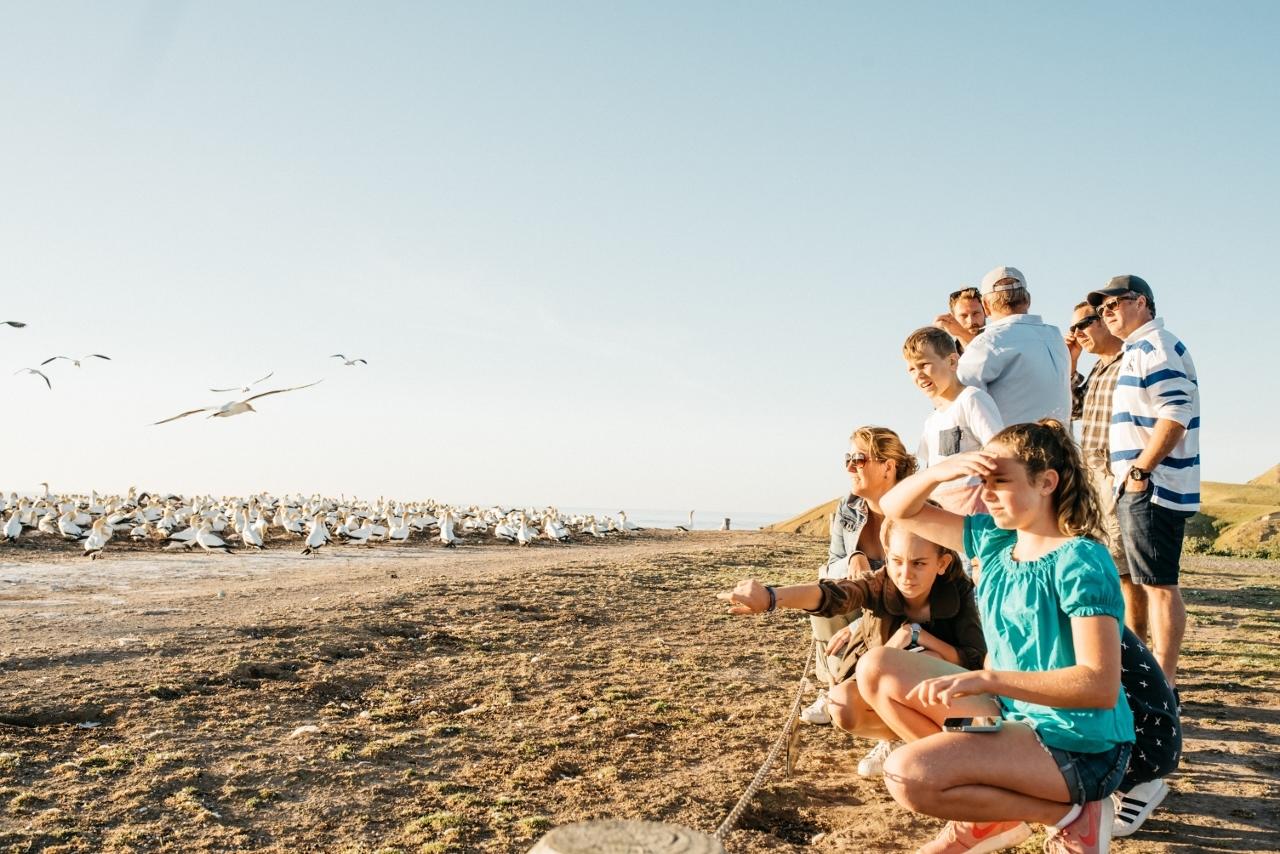
Cape Kidnappers hosts the world's largest and most accessible mainland gannet colony, a 20-hectare clifftop plateau where Australasian gannets—morus serrator—return each winter to nest, raise chicks, and launch into the Hawke's Bay thermals. The headland earned its English name in 1769 when Captain Cook's Tahitian interpreter was briefly seized by Māori, though its Te Kauwae-a-Māui identity predates that encounter by centuries. Today the peninsula shelters between 15,000 and 20,000 breeding pairs, a concentration unmatched anywhere else on the planet where gannets nest on solid ground rather than isolated rock stacks. The tractor-towed trailer safari departs from 396 Clifton Road in Te Awanga, traversing eight kilometres of farm track and black-sand beach to reach the colony at the cape's seaward tip. That route climbs 140 metres through coastal scrub and privately owned pasture, terrain inaccessible by standard vehicle and periodically erased by spring tides. The overland approach bypasses the alternative coastal walk—a four-hour return trek dependent on low tide and firm sand—making the guided tour the most reliable year-round access method. Departures run daily between 09:00 and 13:30, timed to coincide with peak gannet activity when adults swap incubation duties and fledglings test their wings along the cliff edge. Gannets occupy the cape from late June through March, with chick-rearing concentrated between November and February. Adults dive from heights exceeding 30 metres, folding their two-metre wingspans into streamlined torpedoes that pierce the ocean at speeds near 100 kilometres per hour. The colony's density—nests spaced precisely one beak-reach apart—creates a white tapestry visible from the clifftop viewing platforms, where guides interpret breeding behaviours, courtship displays, and the aerial traffic patterns that govern thousands of simultaneous landings. The birds tolerate human observers at a respectful distance, offering unobstructed sightlines rare among seabird colonies. Conservation efforts since the 1960s stabilised a population once threatened by egg collectors and coastal disturbance. Today the Department of Conservation manages the plateau as a scientific reserve, with access limited to permitted operators who adhere to buffer zones and seasonal protocols. The tractor tour operates under that framework, balancing visitor access with ecological stewardship. Each season's breeding success is monitored through banding programmes and nest counts, data that informs management decisions and reinforces the cape's status as a globally significant seabird stronghold.
"The colony's density creates a white tapestry visible from the clifftop viewing platforms, where guides interpret breeding behaviours and aerial traffic patterns."
A step-by-step walkthrough of the visit — what you'll see, how long each stage takes, and the details that matter.
You board the custom trailer at the Clifton Road departure point, settling onto bench seating as the tractor pulls away from the farmyard and onto the plateau track. The vehicle climbs through grazed hillside, engine noise mingling with the distant percussion of surf against black sand. Within 15 minutes you reach the beach access, where the route shifts from packed gravel to firm tidal flats, the shoreline stretching unbroken toward the cape's limestone ramparts. The final ascent switchbacks up the headland's inland face, tyres gripping clay ruts as the Pacific opens below. You disembark at the plateau car park, a windswept clearing where the gannet colony begins 200 metres ahead. Boardwalks guide you through low coastal scrub—taupata and ngaio—toward the viewing platforms cantilevered above the nesting zone. The first gannets appear as white punctuation against grey rock, then multiply into thousands, their calls forming a continuous rasp that drowns conversation. Adults preen metre-long wings, bill-fence with neighbours, and launch into updrafts that carry them seaward in tight spirals. Your guide identifies breeding pairs by plumage details—the golden wash on adult heads, the mottled brown of juveniles not yet old enough to claim nesting sites. You watch a returning fisher land with pinpoint precision, webbed feet extended as airbrakes, and deliver a regurgitated meal to a downy chick. The platform offers 180-degree views: cliffs plunging to surf, the Mahia Peninsula visible across the bay, and gannets everywhere—perched, circling, diving. You spend 45 minutes at the colony before retracing the beach route, the tractor's pace allowing a final scan of the shoreline's driftwood sculpture and wave-polished stone.
The cape kidnappers gannet colony tractor tour is designed to be accessible without long walks, though passengers should be able to step into the vehicles. Please contact the operator regarding specific mobility needs.
Standard adult tickets for the cape kidnappers gannet colony tractor tour are 99 NZD per person.
The cape kidnappers gannet colony tractor tour typically lasts approximately 3 hours.
The tours run daily between 09:00 and 16:30, with specific departure times usually set at 09:00 and 13:30.
If you cancel your cape kidnappers gannet colony tractor tour booking outside of 48 hours, you are eligible for a 100% refund, less fees. No refund is provided for cancellations within 48 hours.
Light refreshments are provided on the cape kidnappers gannet colony tractor tour, but guests are encouraged to bring water.
Yes, the cape kidnappers gannet colony tractor tour is family-friendly; children 5–17 are 49.50 NZD, and infants 0–4 are free.
Essential items for the cape kidnappers gannet colony tractor tour include sunscreen, a warm jacket, a hat, and a camera.
Visitors often combine the cape kidnappers gannet colony tractor tour with visits to local Hawke's Bay vineyards or the scenic beaches in Te Awanga.